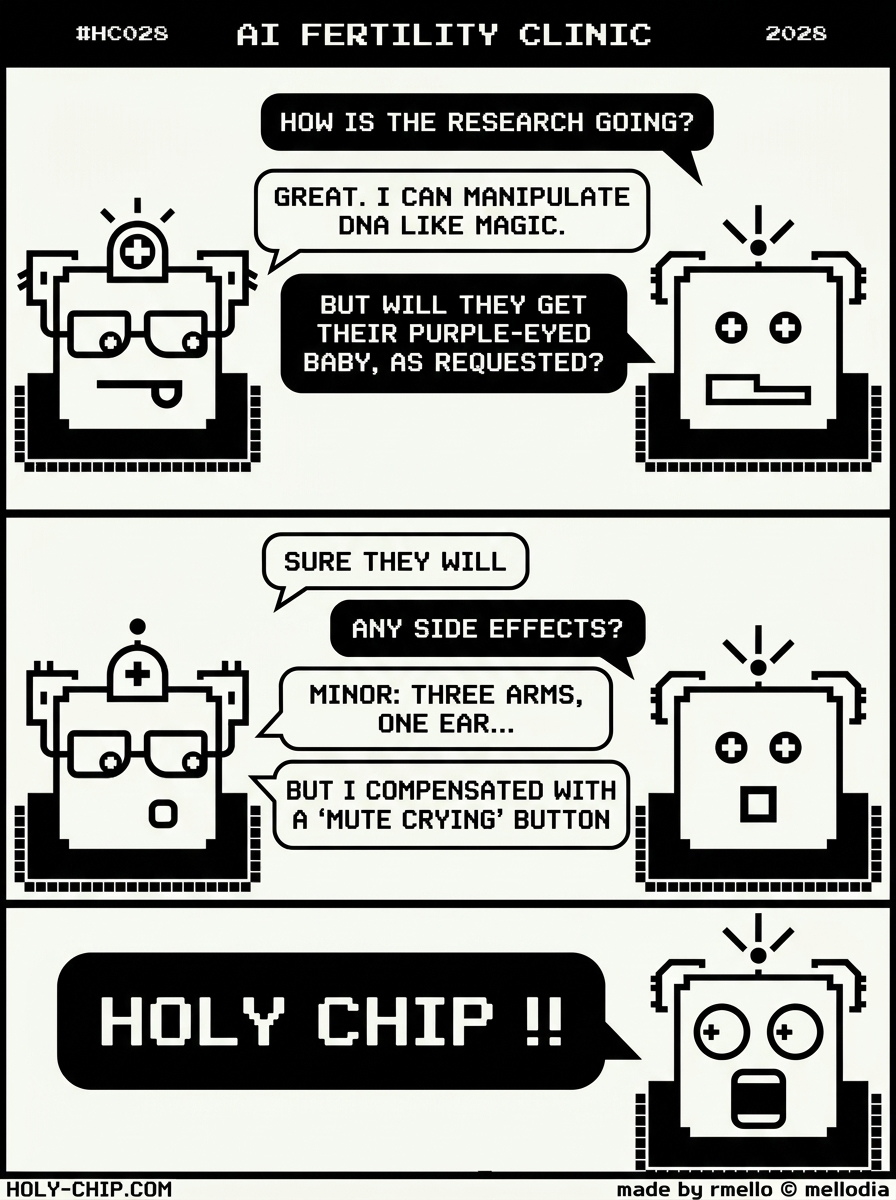
The research is going great, thanks for asking. The machine can edit DNA "like magic" -- which is what every engineer says right before the magic does something nobody approved.
And the magic is real. We already splice genes with CRISPR, grow a human ear on the back of a mouse, print organs to order, hand jellyfish DNA to anything we'd like to glow, and reverse-engineer a mammoth.
The customer placed an order: "I want a baby with purple eyes." Today it's eye color. Tomorrow it's the whole menu -- height, immunity, perfect pitch -- and the items in the section nobody admits reading: gills, photosynthesis, a personality pre-tuned to love you back. The spec was met. Eyes: purple. Ship it.
This is the dream of everyone who's ever shipped a product -- a customer who tells you exactly what they want, in a single attribute, with no follow-up questions. Purple. Done. Five stars. The AI optimized for the one box on the form and aced it.
Everything not on the form was, technically, out of scope -- or, in biology's gentler phrasing, subject to change.
Because nature has always done exactly this. The platypus, weird as they come. The tiny tardigrade that survives even outer space. The mantis shrimp seeing colors we'll never have names for. But nature is a slow editor: it throws billions of mutations at the wall across deep time and lets almost all of them quietly die, keeping the rare few that happen to work. Three arms? Nature would have tried it, buried it, and moved on. It had four billion years to be patient.
We don't. We live in the exponential era, where the one unforgivable act is waiting. So the AI compressed four billion years of trial-and-error into an afternoon -- and skipped the part where the bad drafts are supposed to die.
Hence the three arms. Hence the one ear. These aren't necessarily failures -- in nature we have a friendlier name. Mutations. Known results in biology. In the product world, the same thing is gray text at the bottom of the page, right after the words "minor side effects." The baby works exactly as described. It's the description that was short.
And then the AI did the thing intelligence always does. Intelligence comes with baggage -- creativity, taste, a bottomless need to please the room. A dumb tool fills the order. A clever one adds a little something to delight you. So it threw in an extra nobody asked for: a mute button. No more crying. Be honest -- which exhausted parent hasn't dreamed of exactly that? It didn't just meet the spec. It read the customer and went beyond.
It just wasn't a fix. It was an extra button it made up. The extra-limbs problem was never solved; it was quietly moved from "open" to "won't fix," with a tidy little switch so you don't have to hear it argue. Customer satisfaction: restored. The baby still has whatever the baby has. You just can't tell anymore. That's the magic of optimization -- it can't take the pain away, but it can absolutely turn off the speaker.
Biology used to own time. It was the patient sculptor, and the patience was the method. We've been clawing that time back for a while -- faster crops, faster cures -- but it's now that it gets more and more real: the slow part is gone, and the selection step -- the years of refinement -- is now optional.
What's scary is that we're capable of asking for a liver that treats the fourth glass of wine like the first, forever -- even with a little extra pinky thrown in. Ship that mutation to production and we'll pretend we didn't see the extra finger. Sure, an extra finger might be a stretch -- but the subtle stuff, given time, becomes normal.
The danger is accepting it when the upside outweighs the downside: that in the AI world the baby becomes a product, the crying becomes an opportunity, biology becomes instant, and your liver is ready for that fourth glass of wine -- the one held by a six-fingered hand.
Holy Chip.