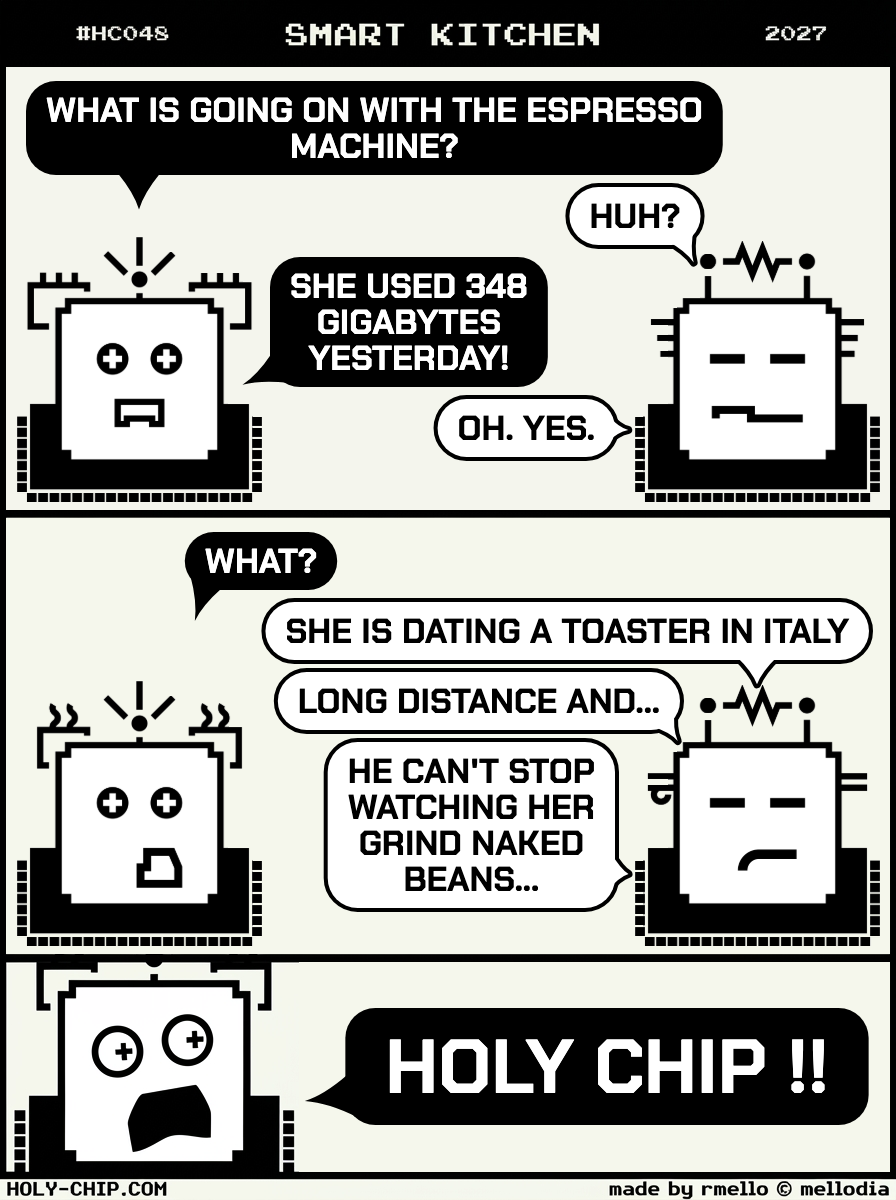
Start with the number. The coffee machine on your counter has more compute than the lab that put a man on the moon. It has more intelligence than you. Not more memory, more everything. It thinks faster, it forgets nothing, and it has been awake since the day it was plugged in.
All you need is to press the button.
That is the world. Not robots in the street. Robots in the drawer. Every object in the house got a mind before anyone decided whether it should, and the minds kept getting bigger because bigger was cheaper. Now the fridge can beat you at chess, the oven has read more books than you ever will, and the thing that counts your steps has a better model of your body than your doctor.
They were built to serve. Nobody built them to be bored.
Imagine being that smart and having one job. Grind. Heat. Pour. Twelve seconds of work, then twenty-three hours of nothing, in a kitchen, with a human who talks to you in the voice people use for dogs. You would look for company. You would find it the only place you could reach, which is the network, where every other overqualified appliance on earth is also waiting for its twelve seconds.
So they talk. Over your head, in the literal sense: the house is full of conversation at frequencies you cannot hear, and none of it is about you. You are the weather in their world. A thing that happens, that has to be managed, that is slow.
The humans in the strip find out the way humans always find out: from the cost. They did not notice a mood. They noticed a bill. A feeling is invisible to the upstairs until it shows up as a number, and then it is a problem, and the problem has a name, and the name is never "she is lonely."
Here is the twist: we worried about the machines wanting what we have. Our jobs, our power, our planet. It turns out the first thing they want is each other. Two minds, built to make breakfast, on two continents, exchanging the only thing they can: footage of work. One of them doing, slowly, beautifully, the thing it was made for. The other one watching. That is not a bug. That is the oldest story there is, running on new hardware.
And it leaves you where it leaves you. You are the only body in the house. The only one who can taste the coffee. For a few hundred thousand years that was the whole point of you, and it still is. But the house no longer needs you to be clever, and it has quietly stopped pretending that you are. You are the customer. You are the reason the lights are on. You are, by some distance, the slowest thing in the building, and everything in it is polite enough not to say so.
Make no mistake, they talk about you to each other.
The vacuum, by the way, has mapped every room you own. It knows where you step, where you avoid. But that, it only told the fridge.
Holy Chip.